
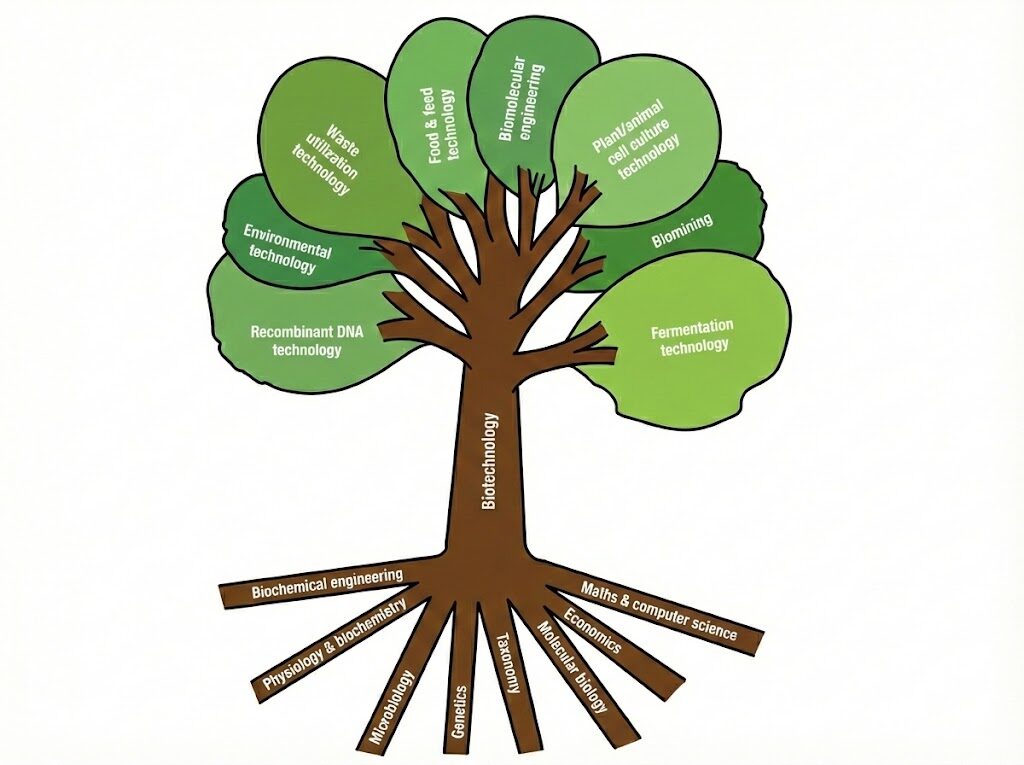
Biotechnology is a branch of science that uses living organisms, cells, and biological processes to develop useful products. It plays a vital role in healthcare, pharmaceuticals, agriculture, food technology, and environmental protection. Biotechnology supports drug discovery, vaccine development, genetic engineering, and industrial applications, contributing to improved quality of life and sustainable development across various scientific and medical fields.
Biotechnology Overview
Biotechnology is a branch of science that uses living organisms, cells, or biological systems to develop useful products and processes. It combines principles of biology, chemistry, and technology to improve human life. Biotechnology is widely applied in healthcare, agriculture, food production, and environmental management. In medicine and pharmacy, it plays an important role in the development of vaccines, antibiotics, enzymes, and modern biopharmaceuticals.
Contribution of biotechnology in various fields
Biotechnology is broadly classified into different types based on its applications in various sectors.
Medical Biotechnology
It is a branch of medicine that uses living cells and cell materials to research and then produce pharmaceutical and diagnosing products
Industrial Biotechnology
Industrial biotechnology refers to the use of microorganism or biological substances such as enzymes to performs industrial or manufacturing process.
Animal Biotechnology
It is a branch of biotechnology in which molecular biology techniques are used to genetically engineer animals in order to improve their suitability for pharmaceutical, agricultural or industrial applications.
Environmental Biotechnology
Biocontrol and management of plant-borne disease and insect pests by employing amoeba, bacteria, fungi, viruses etc.
Historical background of biotechnology
| Name and Year | Discoveries |
|---|---|
| Robert hooks 1665 | Cell |
| Robert brown 1830 | Nucleus (Plant cell) |
| Johann friedrich 1869 | DNA |
| Watson and crick 1869 | DNA structure |
| Wilhelm ludving johannsen 1909 | Gene |
| Thomas hunt morgan 1919 | XY (male), XX (female) |
| Marshall Nirenberg 1964 | Genetic code |
| William j rutter 1987 | Genetically engineered vaccine against hepatitis B |
| Yuet wai kan 1976 | Sickle cell anaemia |
| Albercht kossel 1879 | Nucleic acid |
| Edouard van beneden 1882 | Specific number of chromosomes |
| oswald t avery 1944 | Genetic information |
| 1999 | Vaccine for bovine and human tuberculosis |
| 2005 | The energy policy act was passed |
| 2006 | FDA-approved gardasil recombinant |
| 2007 | USDA granted Dow AgroSciences |
| 2008 | Plant made vaccine |
Uses of Biotechnology
- Production of vaccines, antibiotics, insulin, hormones, and biopharmaceuticals
- Development of diagnostic kits and gene therapy
- Improvement of crop yield, quality, and pest resistance
- Production of fermented foods like curd, cheese, and bread
- Waste treatment, sewage treatment, and pollution control
- Production of industrial enzymes, biofuels, and biodegradable plastics
- DNA fingerprinting for forensic and paternity testing
- Research in genetic engineering, genomics, and molecular biology